Viewpoint
Why is women’s participation higher in NGOs?

While conducting research on women’s employment globally and its historical progression, a particular piece of data caught my attention.
Although the employment of women remains quite low across many professional fields, their participation in organizations known as NGOs (Non-Governmental Organizations) exceeds 75 percent.
While this high proportion might appear positive at first glance, it also has an aspect that warrants further questioning. As you know, NGOs are generally organizations that operate on the basis of volunteerism. Some might argue that it is only natural for women to outnumber men in such settings.
In fact, this is precisely the most problematic aspect of the matter.
Let us elaborate on this subject a bit.
As is well known, there is a prevailing perception and mindset among men globally that is reluctant to provide women with pay commensurate with the effort they put into their work. This is the general situation across the world. In almost every sector, women do not receive equal pay for the same work they perform alongside men. Indeed, this social reality is a subject that is—quite rightly—being discussed all over the world.
Many analyses could be made regarding the reasons for this. Naturally, historical perceptions and habits also play a role. Let me provide a simple example of something that might shape these perceptions. For instance, our mothers work 10–15 hours a day at home, yet they receive no payment for it. Historically, from a child’s perspective, the primary figure in the household with access to financial resources is the father—that is, the male. The mother, by contrast, only has money if her husband chooses to provide it to her. Between 80 and 90 percent of the men over the age of 60 who currently hold decision-making positions globally were raised in this type of family environment.
There are many such underlying factors—residing in the subconscious—that contribute to the failure to pay women what they deserve. In fact, this is also one of the reasons why men tend not to be very prominent in volunteer-based roles that offer no financial return.

Furthermore, this is one reason why women often make no financial demands when engaging in volunteer-based work. In a sense, women are beings who live to sustain life. This characteristic also explains why they show such a strong interest in professions like nursing; they exist to nurture and sustain life. Conversely, it is perhaps understandable that men—given their historical responsibility for covering household expenses—tend to avoid work that offers no financial return.
However, all these reasons—or rather, excuses—cannot serve as a valid explanation for why women fail to receive the compensation they deserve. There is even an interesting statistic regarding this: NGOs led by women generally receive less funding than those led by men. It is as if there is a prevailing mindset that, even if women are not paid, they will still do everything in their power—without expecting any compensation.
Moreover, the issue is not just about money. Women account for approximately 40–42% of the global workforce. Based on 2024 data, if the current pace continues, it appears it will take nearly 200 years to achieve gender parity in employment.
The highest rates of female representation in management are found in the Americas (34–37%) and Europe (32%), while the lowest rates are in the Middle East and North Africa (16–18%). At the current pace, this gap is not expected to close until around the 2080s. Meanwhile, the proportion of women in senior-level (CEO/executive) positions generally hovers between 18% and 30%.
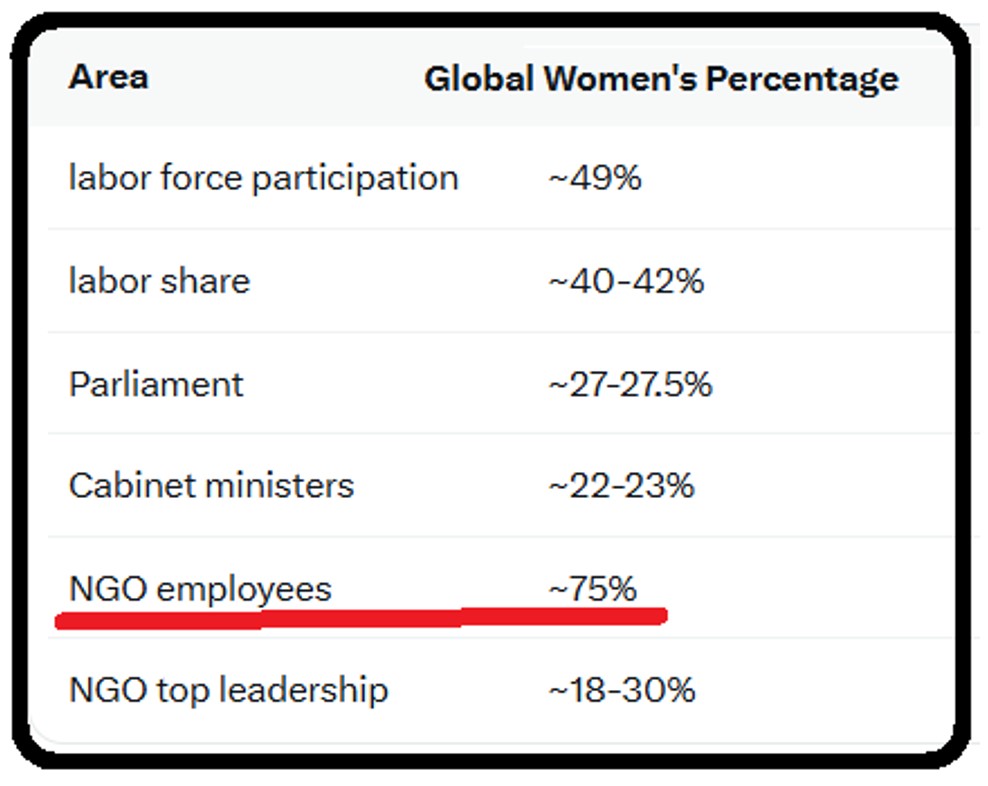
We do not know whether the above-average increase in women’s employment seen since the pandemic has any connection to the fact that women’s wages are lower than those of men.
Women are generally more represented in ministries focused on areas such as social affairs, education, and gender equality, while they remain a small minority in sectors like defense, the economy, and the interior. According to current statistics, women account for approximately 23 percent of ministerial positions in governments worldwide. For those interested, it is worth noting that 28 countries are currently led by women—a figure representing one-seventh of all nations. Meanwhile, more than 100 countries have never been led by a woman at the level of head of state; this group includes nations such as the United States, Spain, and Türkiye.
In short, the situation is this: men in positions of power—who create social space for women within the realm of unpaid, voluntary work—ought to extend that same sense of fairness to women across all professional sectors by ensuring equal pay for equal work. It is a historical reality that where there is no justice, there can be no peace. Let us engage in voluntary work together, and let us be fair and equal toward one another in our professional lives. You will see that the world will become a much more beautiful place as a result.
Written by Prof. Dr. Osman OZSOY