Love of Learning
The Community That Defines University in the Community
“The single most important bond is that of community”
bell hooks
Most of the time when we talk about a community, we assume that we are referring to a group of like-minded people who meet regularly in a public or private setting. Yet, all too often, we gather with people whose language, race, class, education, religion, and values, etc., are just like our own.
Think about the communities to which you belong. How many of those groups are defined by a pervasive sameness of its membership? Being in a community with people who in many ways are just like you asks very little of its members; norms are uncontested and any challenges are easily and comfortably met.
Black, feminist, writer and scholar bell hooks (quoted above), encouraged us to ask more of the social and cultural norms that we take for granted, to make room for the history and experience of all of us. To expand our comfort zones, you could say. To ask more of ourselves in our day-to day lives.
At University in the Community (UitC), a diversity of background and opinion amongst students is integral to the program. We are a group of adults who might not have met each other were it not for a single thread that unites us: everyone is motivated by a desire to learn and to search for meaning in a world that often, as the situation in Ukraine does now, defies reason.
Let me underscore here that without the vision and support of U of T’s Faculty of Arts and Science, Senior College, and Innis College, UitC would not exist. In the highly competitive world of university affairs, U of T has been a steadfast advocate of our free-of-charge program. It is their generosity that allows us to offer a program for people who have never lost the drive to learn but who may not fit the typical student profile.
When UitC meets once a week, participation is key to the success of the class. We know that we won’t necessarily agree with one another all the time. Diversity, as practiced in our classroom (either at Innis College or on Zoom), is more than demographics. It provides us with the space for a plurality of values. And it is that plurality of values that challenges us to step outside our bubble, to truly listen to other opinions, to trust the experience of another’s life, and to respect difference.
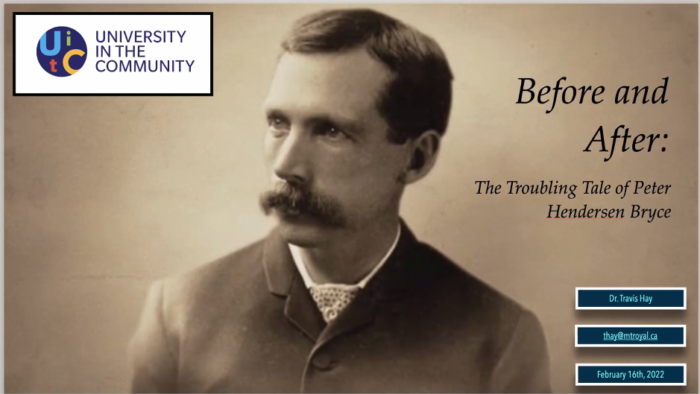
This term, our UitC program explored a number of topics that addressed the wide range of interests of the students. Invited speakers (academics, writers, and artists) brought us into their worlds by engaging us in discussions such as: the work and legacy of Canada’s first medical officer of health, Dr. Peter Hendersen Bryce (Dr. Travis Hay, Mount Royal University, Calgary, Alberta); a personal history of growing up Cree in Churchill, Manitoba (Dr. Brenda Wastasecoot, Centre for Indigenous Studies, U of T); the increasingly urgent need for urban public space (Dr. Luisa Bravo, founder, City Space Architecture, Bologna, Italy); Canada’s policy of refugee determination (Rebecca McTaggart, former Director, Immigration and Refugee Board); how a reporter in a large, daily newspaper chooses the stories representative of Canada’s immigration and refugee issues (Nicholas Keung, Toronto Star); composing and designing sound for a plural world (composer, multidisciplinary artist and facilitator, Ruby Singh, Vancouver, BC); and how to weed out disinformation in today’s news (Jeffrey Dvorkin, journalist, educator, Massey College Fellow at U of T, and author of Trusting the News in a Digital Age, Wiley, 2021).
Last year, we added a four-week Philosophy course to our program in the Spring. (See: Learning Curves Winter 2022, page 7). This year, thanks to the initiative and generosity of philosophers Daniel Munro (U of T) and Zachary Weinstein (Bard College, New York), we are offering another four-week program on Zoom (May 18 – June 8). We will meet as we do now, on Wednesday evenings. Our topic? The multidimensional nature of well-being.
If you would like to join UitC for our Spring program, or for our Fall 2022 program, please send an email to: universityinthecommunity@gmail.com We’d be delighted to tell you more about this most remarkable group of students and speakers.